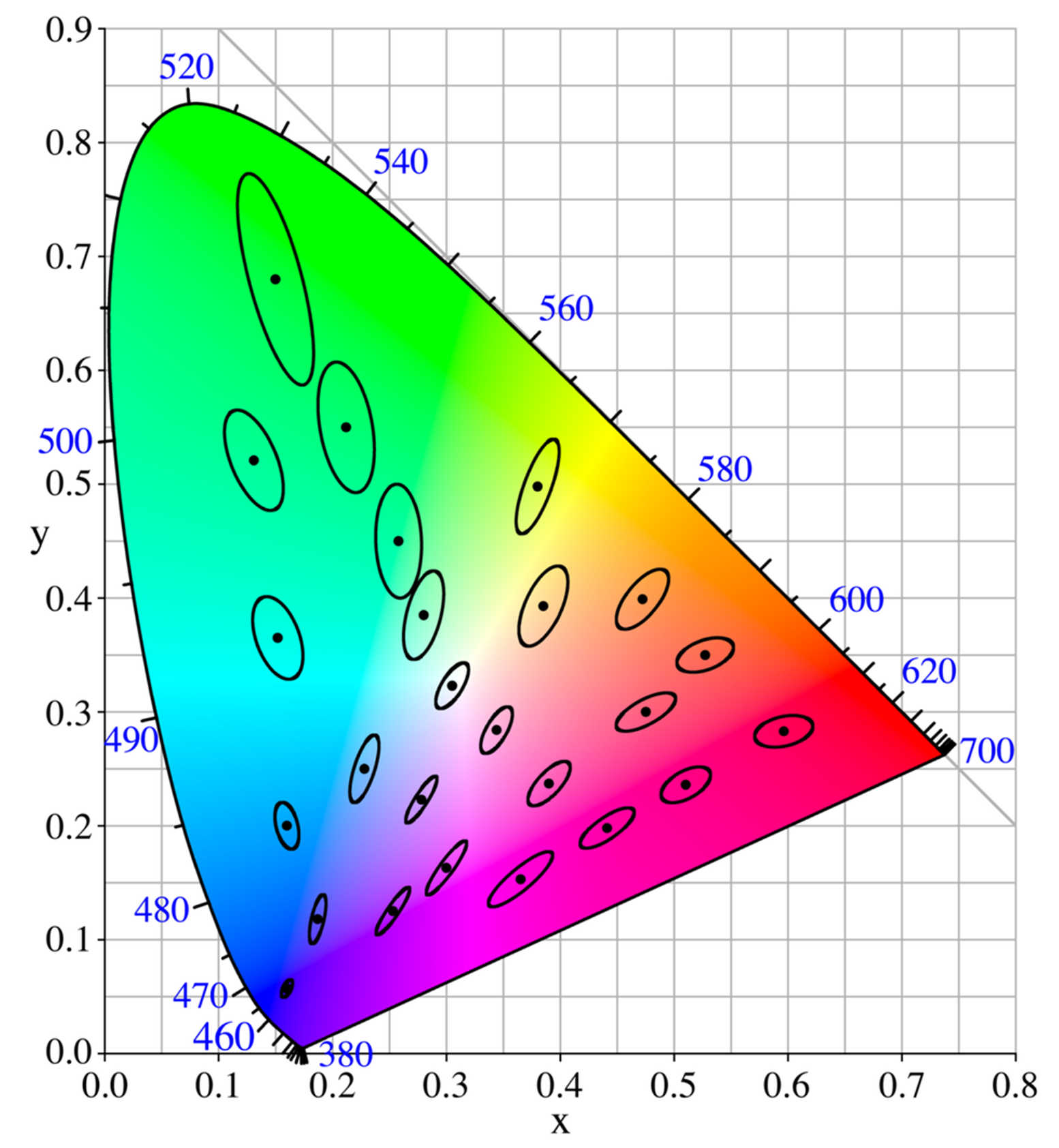
The CIE 1960 color space ("CIE 1960 UCS", variously expanded Uniform Color Space, Uniform Color Scale, Uniform Chromaticity Scale, Uniform Chromaticity Space) is another name for the (u, v) chromaticity space devised by David MacAdam.

The CIE 1960 UCS does not define a luminance or lightness component, but the Y tristimulus value of the XYZ color space or a lightness index similar to W* of the CIE 1964 color space are sometimes used.

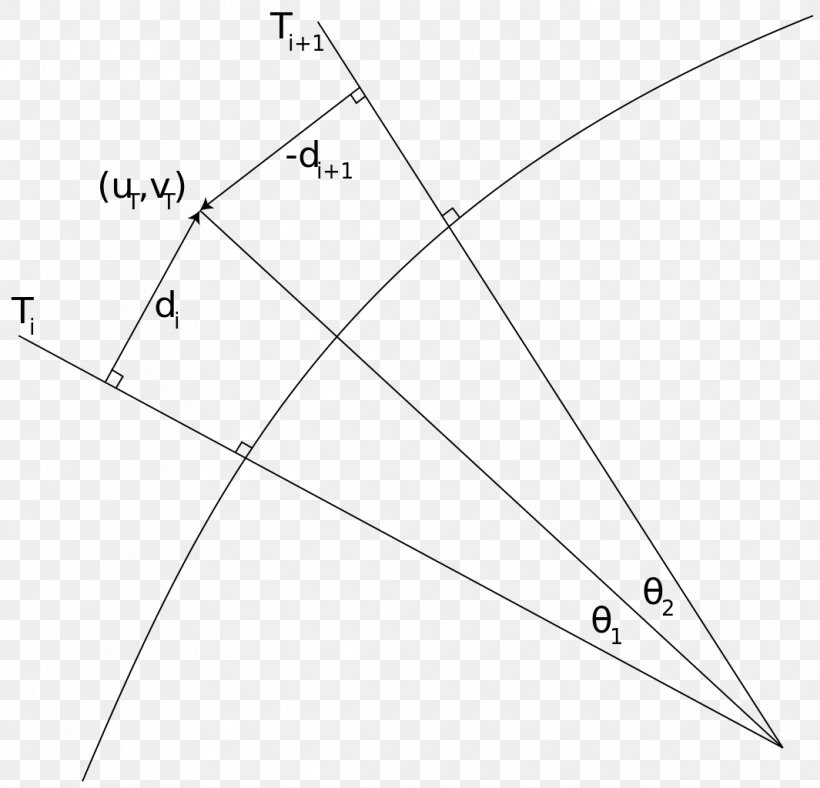
Today, the CIE 1960 UCS is mostly used to calculate correlated color temperature, where the isothermal lines are perpendicular to the Planckian locus. As a uniform chromaticity space, it has been superseded by the CIE 1976 UCS.

Background

Judd determined that a more uniform color space could be found by a simple projective transformation of the CIEXYZ tristimulus values:

( R G B ) = ( 3.1956 2.4478 0.1434 2.5455 7.0492 0.9963 0.0000 0.0000 1.0000 ) ( X Y Z ) {\displaystyle {\begin{pmatrix}''R''\\''G''\\''B''\end{pmatrix}}={\begin{pmatrix}3.1956&2.4478&-0.1434\\-2.5455&7.0492&0.9963\\0.0000&0.0000&1.0000\end{pmatrix}}{\begin{pmatrix}X\\Y\\Z\end{pmatrix}}}

(Note: What we have called "G" and "B" here are not the G and B of the CIE 1931 color space and in fact are "colors" that do not exist at all.)

Judd was the first to employ this type of transformation, and many others were to follow. Converting this RGB space to chromaticities one finds

u J u d d = 0.4661 x 0.1593 y y 0.15735 x 0.2424 = 5.5932 x 1.9116 y 12 y 1.882 x 2.9088 {\displaystyle u_{\rm {Judd}}={\frac {0.4661x 0.1593y}{y-0.15735x 0.2424}}={\frac {5.5932x 1.9116y}{12y-1.882x 2.9088}}}
v J u d d = 0.6581 y y 0.15735 x 0.2424 = 7.8972 y 12 y 1.882 x 2.9088 {\displaystyle v_{\rm {Judd}}={\frac {0.6581y}{y-0.15735x 0.2424}}={\frac {7.8972y}{12y-1.882x 2.9088}}}

MacAdam simplified Judd's UCS for computational purposes:

u = 4 x 12 y 2 x 3 {\displaystyle u={\frac {4x}{12y-2x 3}}}
v = 6 y 12 y 2 x 3 {\displaystyle v={\frac {6y}{12y-2x 3}}}

The Colorimetry committee of the CIE considered MacAdam's proposal at its 14th Session in Brussels for use in situations where more perceptual uniformity was desired than the (x,y) chromaticity space, and officially adopted it as the standard UCS the next year.

Relation to CIE XYZ

U, V, and W can be found from X, Y, and Z using:

U = 2 3 X {\displaystyle U=\textstyle {\frac {2}{3}}X}
V = Y {\displaystyle V=Y\,}
W = 1 2 ( X 3 Y Z ) {\displaystyle W=\textstyle {\frac {1}{2}}(-X 3Y Z)}

Going the other way:

X = 3 2 U {\displaystyle X=\textstyle {\frac {3}{2}}U}
Y = V {\displaystyle Y=V}
Z = 3 2 U 3 V 2 W {\displaystyle Z=\textstyle {\frac {3}{2}}U-3V 2W}

We then find the chromaticity variables as:

u = U U V W = 4 X X 15 Y 3 Z {\displaystyle u={\frac {U}{U V W}}={\frac {4X}{X 15Y 3Z}}}
v = V U V W = 6 Y X 15 Y 3 Z {\displaystyle v={\frac {V}{U V W}}={\frac {6Y}{X 15Y 3Z}}}

We can also convert from u and v to x and y:

x = 3 u 2 u 8 v 4 {\displaystyle x={\frac {3u}{2u-8v 4}}}
y = 2 v 2 u 8 v 4 {\displaystyle y={\frac {2v}{2u-8v 4}}}

Relation to CIE 1976 UCS

u = u {\displaystyle u^{\prime }=u\,}
v = 3 2 v {\displaystyle v^{\prime }=\textstyle {\frac {3}{2}}v\,}

References

External links

  • Free Windows utility to generate chromaticity diagrams. Delphi source included.
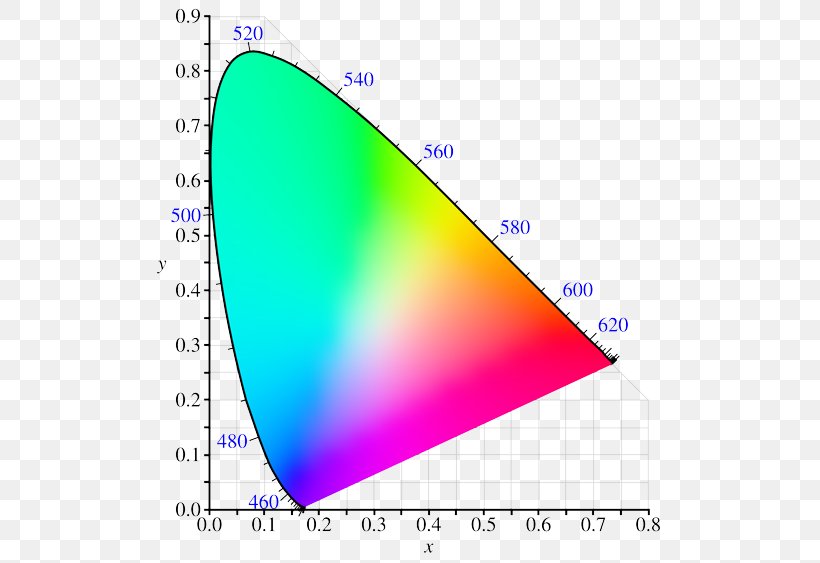
CIE 1931 Color Space RGB Color Space Chromaticity, PNG, 530x563px, Cie

What is the CIE Color Space? What’s the difference between CIE 1931 and

CIE1931_diagram_in_LAB_space.svg Lule Grafiska

CIE1960色度空间

Chromaticity CIE 1960 Color Space Color Temperature International